
Review · ATHENS MYTHOLOGY TOURS
Mythology, Philosophy and Democracy Tour
Ancient Athens comes into focus when you connect its stones to the ideas debated in its streets. This walk links the burial ground at Kerameikos, the civic heart of the Ancient Agora and the Pnyx, where citizens gathered to take part in early democracy. Guide Panos ties mythology, history and philosophy together, so the city feels less like a collection of ruins and more like a place where arguments about how to live were made in public.
I like two things especially: the route reaches lesser-visited places as well as familiar central sights, and Panos gives the walk an intellectual thread rather than delivering a string of dates. The final stop on Philopappos Hill adds some of the best Acropolis views in Athens, with time to talk through what you have seen.
One consideration: this is a walking tour built around ideas, not a quick monument checklist. The advertised duration is about three hours, but discussion and the long final hill stop can stretch the outing. In summer heat, the uphill sections may feel harder, so plan your timing and bring water.
What to know before you book
- Kerameikos connects the city’s public life with its funerary traditions. It was a place of ceramic workshops and a cemetery for centuries, and the tour links it to Pericles’ famous speech praising Athenian democracy.
- The Ancient Agora was Athens’ civic meeting ground. Expect discussion of the philosophers, politicians and citizens who debated public affairs there.
- The route balances famous ideas with everyday Athens. Monastiraki’s flea market and the lanes of Plaka bring the ancient sites into the present-day city.
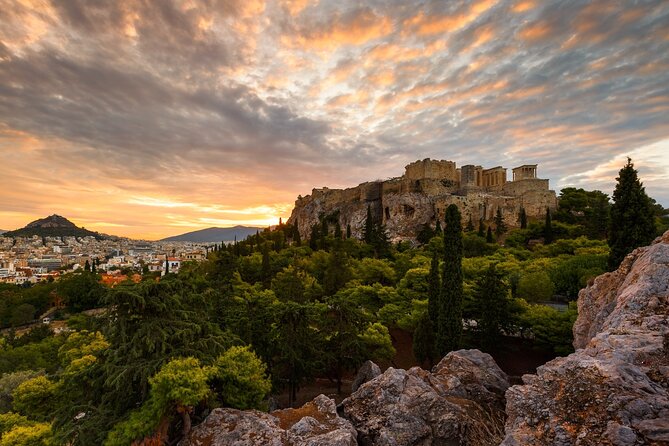
- Pnyx Hill puts democracy in its physical setting. This was the gathering place for the Athenian assembly, and it also offers a broad view across the area.
- Philopappos Hill is the scenic finish. The final stop is scheduled for 45 minutes, with views toward the Acropolis and Athens.
- The group is capped at 12 people. At $50.69 per person, the value rests on a small-group guide-led experience rather than included admission or transport.
A walk through Athens’ ideas, not just its monuments

The Mythology, Philosophy and Democracy Tour is a guided walk through central Athens that asks you to look beyond columns and carved stone. Its central subject is how ancient beliefs and public debate developed into ways of thinking about nature, society and government. That gives the route a clear purpose: each stop adds a piece to the story.
Panos is the named guide associated with the experience. His approach, as reflected in the tour’s descriptions and comments from people who have joined, leans on storytelling, humor and questions that invite you to think. The emphasis is not simply on memorizing who built what. You are asked to consider why ideas took root in Athens and how old political and philosophical questions still sound familiar.
That style will suit you if you enjoy history with room for conversation. It may suit teenagers and adults particularly well: the themes are substantial, and one family found the material engaging for young people. If you want a tightly timed tour that focuses on architectural details or enters every site, this may not be the best fit.
More mythology tours from Athens:
- Athens: Mythology of Delphi, Museum and Arachova Guided Tour
★ 4.6 · 4,008 reviews - Athens & Acropolis Highlights: Greek Mythology Small-Group Tour
★ 5.0 · 2,370 reviews - Athens: Acropolis and Mythology Highlights Small Group Tour
★ 4.8 · 2,275 reviews
Kerameikos: workshops, graves and the public memory of Athens
The walk begins at the Statue of Theseus and heads to Kerameikos, an area named for its ceramic workshops. It also served as Athens’ cemetery for many centuries, giving the stop a different feel from the city’s better-known temples and public squares. Here, the story of Athens includes not only its famous thinkers but also the people the city chose to remember.
The tour connects Kerameikos with Pericles’ funeral speech, which praised the virtues of democracy and the character of the Athenians. The speech was given in honor of those who died in the Peloponnesian War. Hearing about it at a place associated with burial and remembrance gives the political ideals a human cost: democracy was not an abstract slogan, but part of a city’s public life in a time of conflict.
You spend about 25 minutes here, and admission is listed as free. That is enough time for a focused introduction, not an exhaustive visit to every part of the site. I would pay attention to the guide’s explanation of how public memory, war and political identity intersect. Those connections set up the rest of the walk.
The Ancient Agora: where public life met argument
The Ancient Agora was the heart of Athens, a place where citizens went about civic and daily business. Philosophers such as Socrates and Plato, and political figures including Solon, Themistocles and Pericles, are associated with the debates and decisions that shaped the city. The tour’s account also brings in playwrights and historians, showing how politics, drama and historical writing belonged to the same public culture.
The planned stop is about ten minutes, so think of it as an introduction rather than a full archaeological visit. You will get the context for why the Agora mattered and how discussion was part of Athenian life. If you want more time among the ruins, consider returning on your own after the tour.
This is where the tour’s broader theme becomes especially clear. Democracy was not born as a finished system. It developed through public participation, argument and disagreement, and the Agora provides a setting for understanding that process.
Monastiraki and the Roman Agora: old Athens alongside the living city
From the Ancient Agora, the route passes through Monastiraki Square and its flea market, where antique and tourist shops add a change of pace. This brief walk is a useful reminder that Athens is not an archaeological park set apart from ordinary life. People still move through these streets for shopping, work and errands, while the ancient remains sit close by.
The stop is around ten minutes, so there is little time for browsing. Treat it as a chance to notice the city’s shifts in atmosphere rather than as a shopping break. If a particular shop catches your eye, you may want to return later.
The Roman Agora follows, north of the Acropolis and east of the Ancient Agora. Its position helps explain how the city continued to change under Roman rule. The tour spends about ten minutes here, enough for a short historical orientation but not a detailed site visit.
More philosophy tours from Athens:
- Philosophy and Democracy tour of Athens
★ 5.0 · 285 reviews - Athens Highlights: Myths & Philosophers Walking Tour
★ 5.0 · 125 reviews - Athens: the Great Greek Philosophers Guided Tour in Spanish
★ 4.9 · 59 reviews - Aristotle’s Philosophy Experiential Workshop, Lyceum, Athens
★ 5.0 · 5 reviews
The Tower of the Winds and Hadrian’s Library

The Tower of the Winds is one of the route’s more unusual stops. Built in the first century BC by the astronomer Andronicus of Kyrristos, it served as a wind indicator and a clock. Its combination of weather observation and timekeeping makes it an appealing link between ancient architecture and early scientific thinking.
The account shared on the tour describes a solar clock for clear days and a hydraulic mechanism that could mark the hour when clouds blocked the sun. That makes the building more than a handsome octagonal structure: it was a practical instrument for understanding and measuring the world. You have about ten minutes here, so listen for the details that explain how its design worked.
Hadrian’s Library offers another shift in period. The Roman Emperor Hadrian created it in AD 132 on the north side of the Acropolis, and it was once among the largest libraries in the world. The tour’s stop is short, but the site helps show how Athens retained its cultural importance under Roman rule.
Together, these two stops support the walk’s movement from myth and religious belief toward observation, learning and organized knowledge. You are not expected to become an expert in ancient science in ten minutes. Instead, the guide helps you see that the history of ideas was tied to buildings and public institutions as much as to famous names.
Plaka: a change of pace in the old neighborhood

Plaka’s small houses and narrow streets offer a more intimate scale after the public spaces and archaeological sites. The neighborhood is scenic, and the walk through it gives you a chance to see how Athens’ older urban fabric fits into the modern city.
This is a passing stop, not a dedicated neighborhood tour. Still, it helps break up the sequence of historical explanations. As you walk, you can compare the close, human scale of Plaka’s lanes with the open civic spaces where Athenians gathered to debate.
Pnyx Hill: democracy with a view

Pnyx Hill is a key stop for anyone interested in Athenian democracy. It served as the gathering place for the assembly, making it a powerful setting for a discussion of citizens taking part in political decisions. The tour describes it as the first parliament in the world, a concise way of pointing to its place in the story of public government.
You have about 25 minutes here. That longer pause matters: the open hill gives the guide room to explain the political significance of the site, while the view helps you orient yourself in the surrounding area. The walk is not just about learning a definition of democracy. It puts you at a place where people met to hear arguments and make decisions.
Pnyx is also known as a spot for sunset views. If your tour time lines up with the evening, the setting may be especially appealing, but the schedule is not specified, so do not book on the assumption that sunset is guaranteed. The stop is free, and the view is part of the experience rather than an extra you have to pay to access.
Philopappos Hill: a scenic and thoughtful finish
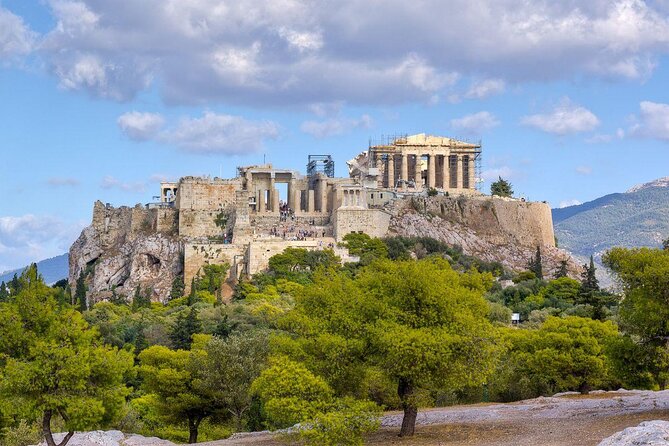
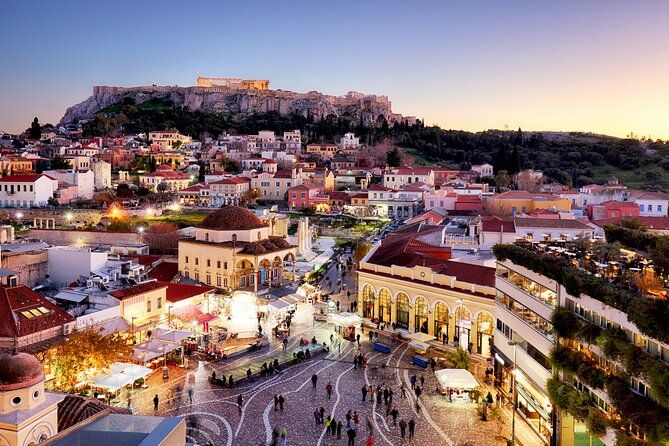
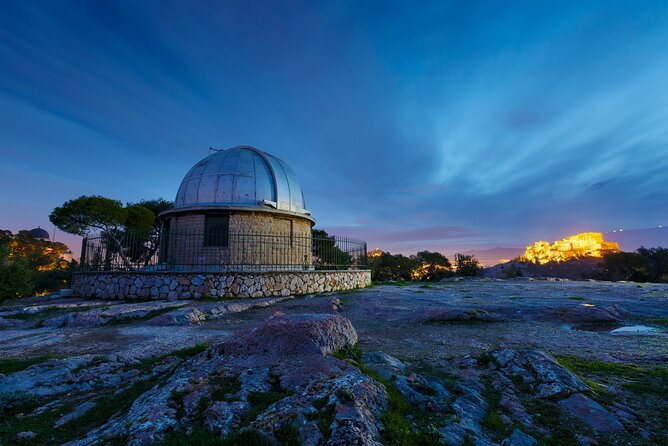
The tour ends on Philopappos Hill, also called the Hill of the Muses. The final stop is scheduled for about 45 minutes, making it the longest pause of the walk. From here, you can take in views toward the Acropolis and across Athens, including the city after dark if the timing allows.
This is more than a photo stop. The route’s final conversation gives you a chance to draw together the themes of mythology, philosophy and democracy. The close has been described as a symposium-style introduction to ancient philosophy, which suits the tour’s spirit: less a lecture with a hard stop, more a chance to keep thinking and talking after the walk.
The hill also makes the route physically demanding near the end. You will have covered several parts of central Athens by then, and there is an uphill element to reaching the viewpoint. Take the walk at a comfortable pace, especially on a hot day. A past tour included water and ice cream pauses in very warm conditions, but it is sensible to bring your own water rather than count on a particular stop.
Is $50.69 good value for this Athens walk?
At $50.69 per person, this tour costs more than a self-guided walk through free public spaces. Its value comes from the guide’s ability to connect places that can otherwise feel like separate stops. If you are interested in democracy, philosophy and the development of ideas, Panos’ explanations are the main reason to pay.
The small-group limit of 12 is a practical advantage. It gives you a better chance to hear the guide and ask questions than you would in a large group. Group discounts are offered, and the tour is in English. Admission to the stops is listed as free, so the price is for the guided experience rather than site tickets.
The trade-off is depth versus breadth. The route includes nine stops in roughly three hours, which means several locations receive only a brief introduction. If your priority is spending an hour inside each archaeological site, plan separate visits. If you want the city’s monuments placed into a connected story, this format offers more than a simple walk between viewpoints.
One practical note on time: the official duration is about three hours, but the route includes substantial conversation, and one description of the outing puts it closer to four. Keep some flexibility in your plans, particularly if you have a timed reservation or dinner afterward.
Who will get the most from this tour?
I would put this walk near the start of an Athens visit if you want a framework for the ancient city before exploring its major sites independently. Several people have found it a useful introduction before visiting the Acropolis, because it gives context for the political and intellectual culture around the monuments.
It is a strong match for curious adults, older teens and families who enjoy asking questions. You do not need a degree in philosophy. The guide’s storytelling and links between historical subjects are intended to make complex themes accessible, while still giving you plenty to think about afterward.
It is less suited to anyone who wants a low-effort outing, a fast route focused on photographs, or a detailed interior visit at every stop. The walk covers several neighborhoods and hills, and the final stop is a viewpoint rather than a museum. In hot weather, consider choosing a cooler time if one is available; an evening in June has been described as more pleasant than a daytime walk.
Confirmation is provided at booking, and service animals are allowed. The activity requires good weather and a minimum number of participants. You can cancel for a full refund up to 24 hours before the start time; later cancellations and changes are not accepted. If poor weather or low enrollment cancels the tour, you are offered another date or a refund.
Should you book the Mythology, Philosophy and Democracy Tour?
Book it if you want to understand the ideas behind Athens as well as see its ancient sites. The strongest reasons are the route’s unusual mix of places, Panos’ lively and thoughtful guiding, and the satisfying finish on Philopappos Hill. It is especially worthwhile for history-minded visitors who enjoy conversation and do not mind a walk with some uphill ground.
Skip it if you want a site-by-site archaeological tour with long visits at every stop, or if you need a short, tightly timed outing. For most curious visitors, though, the combination of public history, philosophy and city views makes this a useful way to spend a half-day in Athens.
FAQ
How long does the tour last?
The advertised duration is approximately three hours. Allow extra time if possible, since the route includes discussion and the final stop on Philopappos Hill.
How much does the tour cost?
The listed price is $50.69 per person. Group discounts are offered.
What language is the tour offered in?
The tour is offered in English.
Where does the tour start and end?
It starts at the Statue of Theseus in Athens and ends on Philopappos Hill.
How many people can join?
The group is limited to a maximum of 12 people.
Are admission tickets included or required?
Admission is listed as free at each of the nine stops.
What happens if the weather is poor or the tour is canceled?
The experience requires good weather and a minimum number of participants. If it is canceled for poor weather or because the minimum number is not met, you are offered another date or a refund.
Just added around Athens
- Athens: Authentic neighborhoods & the beach Bike Tour★ 5.0 · 10 reviews
- Athens: Acropolis & Plaka Neighborhood Private Walking Tour★ 5.0 · 27 reviews
- Athens: Acropolis and Ancient Athens Tour★ 4.8 · 18 reviews
- Athens: Ancient Olympia and Corinth Canal Private Tour★ 4.9 · 5 reviews
- Athens: Acropolis Museum Tour with Skip-the-Line Entry★ 4.8 · 3 reviews
- Athens: Acropolis FULLY PRIVATE Tour with Licensed Guide★ 4.9 · 54 reviews
- Athens: Acropolis Parthenon best sightseeing 4 hours tour★ 4.0 · 5 reviews
- Athens: Acropolis & 2 Museums E-Tickets with 3 Audio Tours★ 4.1 · 18 reviews
Athens Mythology Tours, compared.

Mythology of Delphi, Museum and Arachova Guided Tour
Read our review →
Athens & Acropolis Highlights: Greek Mythology Small-Group Tour
Read our review →

The History of Athens: Greek Mythology Private Tour
Read our review →
Athens Highlights: Myths & Philosophers Walking Tour
Read our review →
Greek Mythology Treasure Hunt for Kids – Athens Private Tour
Read our review →
Browse the lists this tour appears in